

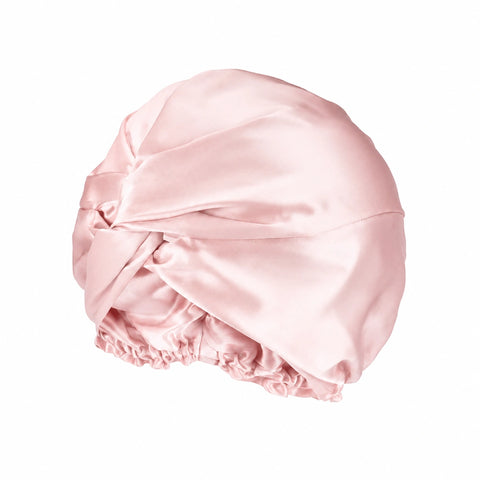


Nighttime hair loss: is pillowcase friction to blame?
The hairs you find on your pillow are mostly normal daily shedding, visibly concentrated when you wake up. A rough or synthetic pillowcase does not affect shedding at the root, but it can make mechanical breakage of the lengths worse. A smooth surface such as mulberry silk reduces this friction. Silk does not treat hair loss that is hormonal, genetic or linked to a deficiency: if you notice significant loss, see a dermatologist.

Finding hairs on the pillow worries a lot of people. The same question always comes up: is my pillowcase damaging my hair at night? Let us look calmly at the role of friction, what is myth, and what can genuinely be improved.
What really happens at night
Every day, we naturally lose roughly 50 to 100 hairs. This figure can rise temporarily (stress, season, pregnancy, hormonal changes). When you wake up, the hairs shed during the night are concentrated in one place — pillow, pillowcase, sheet — which gives the impression of "night-time hair loss", when it is mostly shedding spread over the day, simply more visible.
How friction weakens the fibre
At night, hair goes through repeated movements: changes of position, rubbing, twisting. On a rough material or one that catches, this can lead to breakage of the lengths and ends, hairs "pulled out" at knots, static and split ends. This breakage does not cause loss at the root, but it gives the impression that more hair is falling out because it breaks more easily.
Cotton, synthetic or silk: the differences
| Material | Effect on hair |
|---|---|
| Classic cotton | Absorbs sebum and moisture → drier hair, flattened curls, frizz |
| Synthetic (polyester) | Static electricity, heat build-up, sweating of the scalp |
| Mulberry silk | Smooth surface → less friction, moisture preserved, fewer knots |
Silk offers a smoother surface, with reduced friction compared with many conventional materials. The full comparison is set out in cotton vs silk.
What a pillowcase can — and cannot — do
A better material against your hair can reduce breakage caused by friction, help retain length, protect hairstyles and curls at night, and improve softness. However, it does not make up for:
- hormonal hair loss (postpartum, PCOS, menopause, thyroid);
- androgenetic alopecia (hereditary baldness);
- deficiencies (iron, vitamin D, protein, zinc);
- scalp conditions (seborrhoeic dermatitis, psoriasis);
- the side effects of certain medications.
How to reduce breakage at night
- Detangle gently before bed, starting at the ends with a wide-tooth comb.
- Avoid sleeping with soaking-wet hair: wet hair is more fragile.
- A loose hairstyle: a loose plait, a low bun without tension, or a "pineapple" for curls.
- A protective treatment: a light oil on the ends or a leave-in.
- A smooth surface: a silk pillowcase limits mechanical friction.
- Hygiene: change your pillowcase at least once a week (every 3-4 days if you have oily hair).
Frequently asked questions
A pillowcase is generally not the direct cause of loss at the root, but a very rough, synthetic or poorly maintained material can increase mechanical breakage and give the impression that more hair is falling out.
No. It can reduce mechanical breakage and improve the quality of the lengths, but it does not treat internal causes (hormonal, deficiencies, conditions). It is a lever for comfort and protection, not a medical treatment.
Often a few nights for softness and easier detangling, and 2 to 3 weeks for a visible reduction in breakage. The effects on length retention are measured over several months.
Yes: fine, thick, straight, wavy, curly or afro-textured. Textured and fragile hair often benefits fastest from the anti-friction effects.