

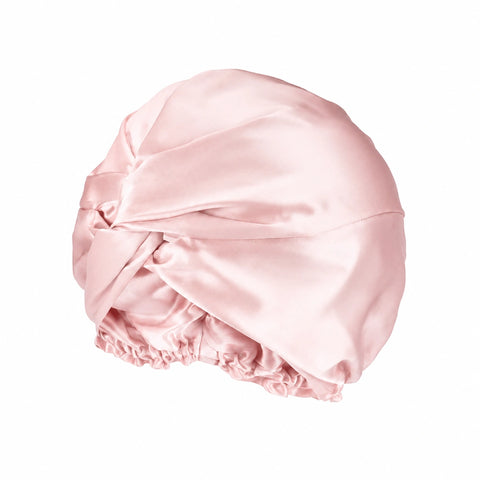


Sleeping During Your Period: Why Skin and Hair React More at Night

What really changes during this time
Your skin may produce more sebum
Around the premenstrual phase, fluctuations in estrogen and progesterone, along with the relative influence of androgens, can lead to oilier skin and pores that clog more easily. This is one reason some people see breakouts appear at that time, often on the lower face (jawline, chin). It doesn't happen every time, but if you notice a regular pattern, it's a useful signal to adapt your habits.
Your skin can become more reactive
When the skin barrier is more sensitive, friction from the pillow, nighttime heat and certain residues (skincare, hair oil, scented laundry detergent) can be felt more strongly: redness on waking, discomfort, tightness.
Your sleep can be disrupted
Menstrual pain, abdominal discomfort, changes in body temperature and hormonal shifts can make it harder to fall asleep or cause micro-awakenings. This is a frequently reported experience during periods.
Why nighttime amplifies oily skin, breakouts and discomfort
- Heat and sweat: the warmer you are, the more sebum and impurities build up on your skin. Body temperature can rise slightly during your period.
- Prolonged contact: your face and hair stay against the fabric for 7 to 8 hours. A pillowcase that traps heat and moisture creates an environment conducive to irritation.
- Residue transfer: night creams, serums, hair oils and sebum migrate onto the pillowcase, which quickly becomes a reservoir of residue.
This transfer issue is key: it's not just the pillowcase material, it's the combination of hygiene + comfort + reduced friction that can make a difference.
Silk pillowcases and acne: the honest version
No: silk does not treat hormonal acne
Cyclical acne is linked to hormonal fluctuations and to how your sebaceous glands respond (sebum production, inflammation, clogged pores). A silk pillowcase does not replace a suitable routine, dermatological treatment, or medical advice when needed.
Yes: it can reduce certain aggravating factors
- Less friction: a smooth surface that limits mechanical irritation, welcome when your skin is already sensitized.
- Better temperature regulation: often feels cooler than synthetics, which reduces nighttime discomfort.
- Less snagging on hair: fewer tangles and less breakage.
- Easier hygiene: silk washes easily and dries quickly, so you can change it often.
Hair during your period: why it reacts
Your scalp also reacts to hormonal fluctuations: shifts in androgens can stimulate the sebaceous glands, which is why hair can get greasy faster as your period approaches, or the hair fiber may snag and tangle more at night.
- If you move a lot in your sleep: friction + tangles = knotted hair when you wake up.
- If you use overnight oils or treatments: transfer onto the pillowcase = hair that gets greasy again faster.
- If you sweat more: heat + moisture = an uncomfortable scalp.
A loose hairstyle (loose braid, low bun) and a smooth surface help limit breakage. Details in cotton vs silk for hair.
Good habits for better sleep
For your skin
- A gentle evening routine: gentle cleanser + light moisturizer, without extra layers if your skin clogs easily.
- Hypoallergenic laundry detergent: avoid heavily scented detergents if your skin reacts.
- Frequent changes: during flare-ups, change your pillowcase every 2 to 3 days.
- Avoid touching your face, especially when sleeping curled up.
For your hair
- A loose hairstyle: satin or silk scrunchie, loose braid (avoid tight hair ties).
- Avoid sleeping with wet hair: moisture + heat + friction = breakage.
- Protect your treatments: tie your hair up if you apply oils or masks.
For your sleep
- A cool, well-ventilated bedroom: aim for 18-19 °C.
- A pillow suited to your body type.
- Stay hydrated during the day.
- Listen to your body: see a healthcare professional if symptoms become debilitating.
Looking for a soft pillowcase that limits friction and snagging during sensitive times?
Discover our silk pillowcases 100% Grade 6A mulberry silk · OEKO-TEX® · Free shippingFAQ — Periods, skin, hair and sleep
Hormonal fluctuations during the cycle (a drop in estrogen, the influence of androgens) can stimulate sebum production and lead to clogged pores, especially in the premenstrual phase. This is known as cyclical acne, and it is very common.
It does not treat hormonal acne, but it can reduce friction and improve comfort. Combined with rigorous hygiene (changing it every 2 to 3 days), it limits certain aggravating factors such as sebum build-up and mechanical irritation.
The scalp reacts to hormonal fluctuations: shifts in androgens can stimulate the sebaceous glands of the scalp. The effect is often more pronounced in the premenstrual phase and amplified by nighttime heat.
During flare-ups (7 to 10 days before your period), change your pillowcase every 2 to 3 days to limit sebum, sweat and skincare residue. Having 2 to 3 pillowcases in rotation makes this hygiene easier.