

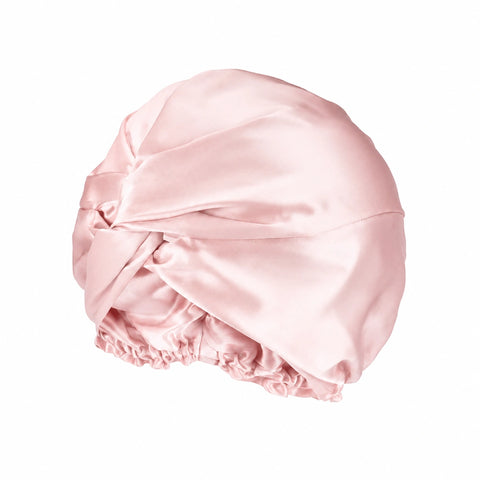


Why sleep with a silk bonnet?
A mulberry silk sleep bonnet wraps your hair in an ultra-smooth surface that limits friction overnight, preserves moisture and keeps curls defined. It is especially suited to curly, tightly curled, coily, color-treated or fine hair. Insist on genuine OEKO-TEX® certified mulberry silk: cheap “satin” is almost always polyester.

Why sleep in a silk bonnet?
At night, without protection, your strands rub against the pillow for hours, which can cause cumulative micro-damage: abraded cuticles, dehydrated fibers, undone curls. A silk bonnet creates a protective shell: its smooth surface lets hair glide without resistance, significantly reducing friction overnight. Note that no accessory “repairs” damaged hair — silk limits mechanical stress but does not replace proper hair care, and results vary depending on hair type.
The benefits of a silk sleep bonnet
Less friction, less breakage
Hair glides freely inside the bonnet, without snagging or tangling. When you wake up: fewer knots, less frizz, fewer broken ends. The effect is often most noticeable on curly and tightly curled hair.
Moisture and hair care preserved
Cotton is absorbent: a cotton bonnet can soak up some of the oils and leave-ins applied before bed. Silk is far less absorbent, which helps your treatments stay on the hair fiber.
Long-lasting hairstyles and temperature regulation
Defined curls, blow-outs and braids stay in place better until morning. Mulberry silk also helps regulate temperature: cool in summer, soft in winter, it limits the overheating that dries out the hair fiber. Over time, less nighttime stress translates into smoother hair — especially for color-treated or bleached hair, which is more porous.
Which hair types is it for?
A silk bonnet suits everyone, but some hair types benefit in particular: curly, tightly curled and coily hair (more raised, more vulnerable cuticle), color-treated or bleached hair (more porous) and fine hair (which gets static and breaks easily). For textured hair, the “pineapple” technique — gathering your curls on top of your head before putting on the bonnet — helps preserve definition. See our guide on which protection to choose for curly or coily hair.
Silk bonnet vs satin bonnet
Satin is not a material but a type of weave: most “satin bonnets” sold online are made of polyester. They look shiny, but create static and offer no temperature regulation.
Bonnet or silk pillowcase: do you have to choose?
The two work hand in hand. The bonnet protects all of your hair; the pillowcase protects the area in contact with the pillow if the bonnet slips. The bonnet is the priority for curly, tightly curled and coily hair; the pillowcase for straight hair or if you prefer not to wear an accessory at night. Our article silk pillowcase vs sleep bonnet compares the two in detail.
Discover our silk sleep bonnets100% Grade 6A mulberry silk · OEKO-TEX® · Free shippingFrequently asked questions
The “satin” used for bonnets is almost always polyester: static electricity, no temperature regulation. Genuine mulberry silk is low-absorbency and gentle on the hair fiber.
Yes, it's the hair type that benefits the most: less friction, better-defined curls and treatments preserved. Use the “pineapple” technique.
Gather your lengths into a loose bun or braid on top of your head, then slip on the bonnet, making sure all your hair is tucked inside.
The two work hand in hand. The bonnet protects all of your hair; the pillowcase protects it if the bonnet slips. For maximum protection, use both.