



Why do we sweat from our heads at night? Causes, mistakes, and solutions
Updated 10 August 2026

Is it normal for your head to sweat at night?
Yes, it is common and usually harmless. A landmark study carried out in general practice by Mold et al. reports that 41% of the patients surveyed said they had experienced night sweats in the previous month1: it is an ordinary reason to see a doctor, not an alarm signal in itself.
What makes the head more exposed than the rest of the body comes down to anatomy. The scalp, forehead and nape of the neck have a high density of eccrine sweat glands, the ones that produce sweat for temperature regulation. And unlike the torso and legs, the head stays outside the duvet: it is the main route by which the body gets rid of excess heat. A bedroom that is too warm therefore produces localised sweating — a damp pillow, a clammy neck — while the rest of the body seems perfectly dry.
The useful distinction is this: sweating that is occasional, linked to heat or to a particular period, is down to the sleep environment. Sweating that is heavy, daily, and forces you to change your pillow or pyjamas, and above all is associated with fever, weight loss or sleep apnoea, is a matter for a doctor.
What causes your head to sweat at night?
Six causes cover almost every case: a bedroom that is too warm, non-breathable bedding, hormonal changes, stress, a sleep-related breathing disorder, and amplifiers consumed in the evening. The table below helps you identify yours based on the sign that accompanies it.
| Cause | Tell-tale sign | 7-day test |
|---|---|---|
| Bedroom too warm | You throw off the covers, wake up overheated, worse in summer | Thermometer in the bedroom, target 16-18 °C |
| Non-breathable bedding | Sweating even when the room is cool; synthetic duvet or polyester pillowcase | Replace pillowcase and duvet cover with a low-friction fibre |
| Hormonal changes | Brief hot flushes, irregular cycles, postpartum, perimenopause | Record episodes on a cycle calendar |
| Stress, mental load | Taking a long time to fall asleep, waking at the same time, rumination | 10 min of slow breathing before bed |
| Sleep-related breathing disorder | Severe snoring, dry mouth, morning headaches, daytime sleepiness | Do not self-treat: seek medical advice |
| Alcohol, late meals, caffeine | Sweating only on the evenings concerned | Cut out for 3 consecutive evenings, compare |
What does a wet pillow in the morning mean?
A damp pillow in the morning signals a heat-sweat-micro-awakening loop, not a medical condition. The mechanism is mechanical: the body produces sweat to cool down, the fabric holds it, the feeling of dampness causes a micro-awakening, you change position, and the thermal effort starts again. It is this loop that fragments sleep, not the sweat itself.
The material of the pillowcase determines how long the moisture stays in contact with the skin, and that is where the choice matters. A fibre with a high moisture regain absorbs sweat without feeling wet, then dries quickly; a synthetic fibre keeps it on the surface. This is the main criterion for choosing a silk pillowcase when your head sweats, and the full comparison of materials is set out in which pillowcase fabric stays coolest.
What are the effects on facial skin?
Night sweating is not comedogenic in itself, but it increases how much the skin sticks to the fabric, and therefore friction. On a cotton pillowcase, whose surface has a high coefficient of friction, every change of position pulls on the skin of the forehead, cheeks and chin: hence redness, pillow creases and tightness in the morning.
On top of this is a hygiene factor. A pillowcase accumulates sebum, sweat, skincare residue and shed skin cells; in a damp environment at 30-33 °C against the skin, this is a favourable substrate for bacterial growth. The consistent dermatological recommendation is to change it every 2 to 3 days for reactive skin, compared with 7 days for normal use — the full reasoning is in how often to change your pillowcase. On the link with blemishes, see why spots appear at night.
What are the effects on hair?
Sweat damages hair through two distinct mechanisms: the opening of the cuticle scales under the effect of moisture, and mechanical abrasion from rubbing against the pillow. Hair is a hygroscopic keratin fibre: in a humid atmosphere, the cuticle scales lift, the fibre swells, and frizz appears. A fibre with an open cuticle catches on its neighbours — hence knots — and loses its alignment, and therefore its shine and curl definition.
- Frizz: moisture + open scales = increased apparent diameter.
- Flattened curls: prolonged compression on the same area, loss of definition from the very first night on curly to afro-textured hair.
- Knots and breakage: cuticle-against-cuticle friction, worse on long, coloured or bleached hair whose cuticle is already weakened.
- Heavy roots: heat and sweating of the scalp stimulate sebaceous activity. Waking up with greasy roots is not always a shampoo problem.
A comparison of materials with figures in cotton vs silk: why your pillowcase damages your hair.
The silk bonnet: keeping hair away from contact
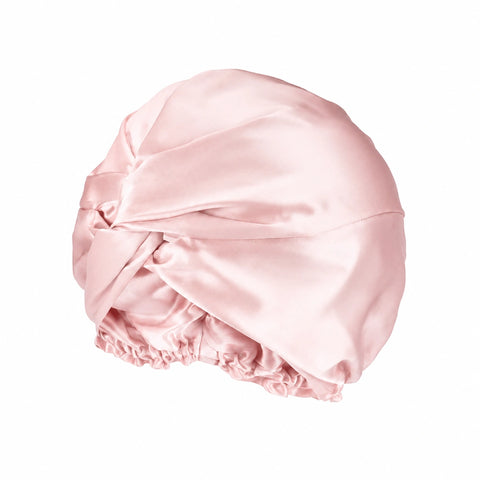
The silk bonnet solves a problem that a pillowcase cannot: it physically removes the hair from the contact surface. A pillowcase protects the area your face rests on, but long hair sweeps across the pillow with every movement, including outside the protected area. The bonnet encloses the lengths in a closed, low-friction space where the fibre only rubs against itself.
On curly, wavy or afro-textured hair, it is the accessory with the most visible effect in a single night, because the loss of definition is immediate. On long, straight hair, the benefit is mainly on knots and split ends. How to use it is explained in detail in why sleep in a silk bonnet.
| Criterion | Mulberry silk | Polyester satin | Cotton / jersey |
|---|---|---|---|
| Type of fibre | Natural, protein (fibroin) | Synthetic, petroleum-based | Natural, cellulose |
| Friction on the cuticle | Very low | Low | High |
| Moisture regain2 | ≈ 11% | ≈ 0.4% | ≈ 8.5% |
| Heat release | Good, fine and breathable fibre | Poor, occlusive effect | Medium, dries slowly |
| Durability | Several years if washed cold | Pills, loses its glide | Loses its shape, bobbles |
| Verdict for night sweats | The best compromise | Avoid | Avoid |
The conclusion is clear: satin is the worst choice if your head sweats. It is also the best-selling, because "satin" sounds like a material when it is simply a type of weave — the glide is there, but with a moisture regain of 0.4%, the synthetic fibre does not manage any moisture and creates an occlusive effect on the scalp. Cotton, for its part, is breathable but has the highest friction of the three: it deals with heat and makes frizz worse. Mulberry silk is the only one of the three that is both low-friction and breathable — see our comparison of 11 silk bonnets.
Fabric weight is expressed in momme (mm), the traditional unit for silk: 1 momme is roughly 4.3 g/m². A 19 momme bonnet therefore weighs ≈ 82 g/m², a 22 momme ≈ 95 g/m². Below 16 momme, silk becomes too thin to withstand washing. The Grade 6A label refers to the highest grade of Bombyx mori filament: long, even thread with no slubs — this is what gives the smooth surface. Finally, OEKO-TEX® Standard 100 certification guarantees the absence of harmful substances in the finished product, which matters for a textile worn directly against the scalp eight hours a night. The details of the thresholds are in our guide to 19, 22, 25 and 30 momme weights.

The standard size. Soft elasticated edge, stays in place all night without marking the forehead. For short to mid-length hair.

Deeper volume to hold the lengths without squashing or folding them. For long, thick or voluminous hair.
How to stop your head sweating at night: the 7-day protocol
Apply all three levers at the same time for seven nights, then remove them one by one to identify the one that matters for you. Here is how to go about it.
- Nights 1 to 7 — bring the bedroom down to 16-18 °C. Turn off the heating in the room, air it for 10 minutes just before bed, and check with a thermometer rather than by feel. This is the most effective measure and the least often applied.
- Nights 1 to 7 — lighten your bedding. A flat sheet plus a light blanket, adjustable layer by layer, rather than a single duvet. A 400 g/m² synthetic duvet is unbearable above 19 °C.
- Nights 1 to 7 — change the contact surface. A low-friction pillowcase for the face, a bonnet for the hair. Keep two pillowcases in rotation: a clean surface every two days changes how it feels more than a weekly wash.
- Nights 1 to 3 — cut out alcohol in the evening. Alcohol causes peripheral vasodilation and fragments the second half of the night. Three evenings are enough to see the difference.
- Every evening — a lukewarm shower, not a hot one. A shower above 40 °C raises core temperature and delays the drop in temperature needed to fall asleep.
- Every evening — dry hair at bedtime. Sleeping with damp hair combines both frizz factors: residual water and friction.
- Every evening — 2 minutes of slow breathing. Breathe in for 4 seconds, out for 6 seconds. It lowers alertness and sympathetic tone, and therefore thermal reactivity.
- Day 8 — take stock. Remove one lever at a time, two nights each, and take notes. You will know which one is producing the result.
If micro-awakenings persist once the temperature is under control, the fabric may not be the only factor: see insomnia and micro-awakenings: the role of pillowcase fabric.
Does your hair spend the night on a damp pillow?
Discover our silk bonnets Grade 6A mulberry silk · OEKO-TEX® Standard 100 · 100-night trialWhich pillowcase should you choose if your head sweats?
Choose a natural fibre with low friction and high moisture regain: mulberry silk meets both conditions, cotton only one, polyester neither. In practice, that means a 100% mulberry silk pillowcase, Grade 6A, 19 or 22 momme, OEKO-TEX® Standard 100 certified.
19 momme (≈ 82 g/m²) is more than enough for heavy summer sweating: lighter, it dries even faster. 22 momme (≈ 95 g/m²) withstands frequent washing better, which matters when you wash every two or three days. The full ranking of criteria is in our comparison of the best silk pillowcases in 2026.
If your sweating episodes come with brief, well-defined hot flushes, the hormonal context deserves to be considered separately: see menopause and night sweats: which fabric to choose.
When should you see a doctor?
See a doctor if the night sweating is heavy and daily, or if it comes with any of the following signs: fever, unexplained weight loss, swollen glands, sweats that force you to change your clothes, severe snoring with pauses in breathing, headaches on waking, marked daytime sleepiness. These point to a cause that needs investigating — sleep apnoea, a thyroid disorder, a side effect of medication — and not to a bedding problem.
This article describes environmental factors and the choice of textiles. It does not constitute medical advice and does not replace a consultation.
Looking for a breathable pillowcase that stays smooth against your skin?
See the full collection 100% Grade 6A mulberry silk · OEKO-TEX® Standard 100 · 100-night trialFAQ — Head sweating at night
Because the head is the only part of the body left outside the duvet, and it has a high density of eccrine sweat glands. It is therefore the main route by which the body gets rid of excess heat. Sweating localised to the head and neck, with a dry body, almost always points to a thermal problem with the bedroom or bedding, not to an internal cause.
Between 16 and 18 °C. This is the range in which core temperature can drop naturally as you fall asleep. Above 19 °C, temperature regulation relies more on sweating, and the head becomes the main area for heat release. Check with a thermometer: how it feels is misleading, especially in winter with the heating on.
A 100% mulberry silk pillowcase, Grade 6A, 19 or 22 momme, OEKO-TEX® Standard 100 certified. Silk combines the two useful properties: a low coefficient of friction and a moisture regain of about 11%, compared with 8.5% for cotton and 0.4% for polyester. 19 momme dries faster, 22 momme withstands frequent washing better. See our 2026 ranking.
Silk, without hesitation, if your head sweats. "Satin" refers to a weave, not a material: almost all satin bonnets on the market are polyester, whose standardised moisture regain is 0.4% compared with about 11% for silk. In concrete terms, polyester does not manage moisture and creates an occlusive effect on the scalp. Polyester satin has the glide of silk, but none of its breathability.
No, mulberry silk is not an occlusive fibre. It is a fine, breathable protein fibre that lets air through and dries quickly. The bonnets that make you sweat are those made of polyester satin or fleece. If you sweat in a silk bonnet, check the bedroom temperature first: the bonnet is not the variable at fault.
19 momme for everyday use, 22 momme for long or thick hair. Momme measures the weight of silk: 1 momme ≈ 4.3 g/m², so 19 momme ≈ 82 g/m² and 22 momme ≈ 95 g/m². Below 16 momme, silk is too thin to withstand repeated washing. Above 25 momme, the gain on a bonnet becomes marginal and the price rises sharply.
Every 2 to 3 days for reactive skin, once a week for normal use. Night sweating speeds up the build-up of sebum and skincare residue. The practical solution is to have two pillowcases in rotation. For silk: wash at 30 °C maximum, with a detergent free of enzymes and bleaching agents, and air dry out of the sun.
Both, and often at the same time. Hormonal changes — cycle, postpartum, perimenopause, menopause — directly destabilise the hypothalamic thermoregulatory centre and produce brief, distinct flushes. Stress acts indirectly: it makes sleep lighter, which multiplies the micro-awakenings during which the body reacts more to heat. A useful clue: hormonal episodes are sudden and contained, while stress-related sweating is diffuse and comes with repeated awakenings.
When they are heavy, daily, and associated with fever, unexplained weight loss, swollen glands, snoring with pauses in breathing, headaches on waking or daytime sleepiness. In these cases, see a doctor: these signs point to a cause that needs investigating, in particular sleep apnoea syndrome or a thyroid disorder.
- Mold JW, Mathew S, Belgore S, DeHaven M. Prevalence of night sweats in primary care patients. The Journal of Family Practice, 2002.
- Moisture regain standardised at 21 °C / 65% RH, reference textile values: polyester 0.4% · cotton 8.5% · silk 11%.
- Weight equivalence: 1 momme ≈ 4.3 g/m² (traditional unit for silk).